

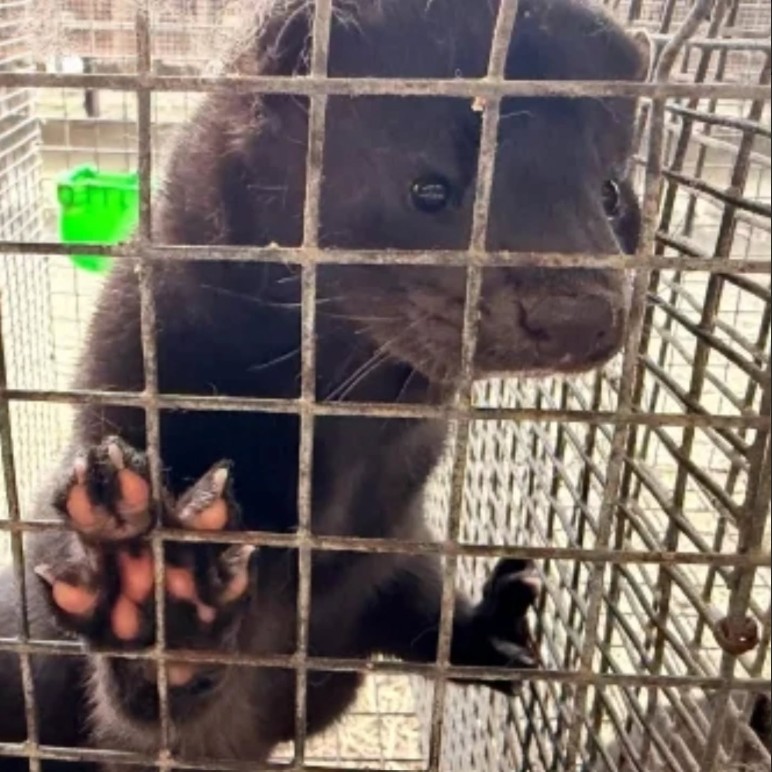
 Historically, June is the beginning of “fur farm raiding season”, when mink born in March mature to a state where they can be liberated into their natural environment.
Since 1995, there have been at least 118 fur farm raids across the United States. Raids peaked in 1997 and 1998, and continued with small surges in 2008, 2011, and a resurgence in 2013.
In 2022, three mink farms were emptied by the Animal Liberation Front. Over 15,000 mink were liberated into their natural environment, and at least one fur farm closed as a result.
2023 saw the ALF visit three fur farms and liberate over 11,000 mink and dozens of foxes.
The anonymous liberators wrote “people need to see the filthy & cramped conditions where these territorial & genetically wild animals are kept up to four in a single cage. and the joy that is possible when they experience freedom.”
Last year, an ALF cell emptied the Aeschelman Fox Farm. This farm once confined hundreds of foxes, and now imprisoned only eighty. All eighty cages on the property were unlatched. A week later, David Tremeel’s mink farm in Iowa would be emptied, with all 2,000 mink freed from a life of subjugation.
“Once we made it through and saw our first mink, we could not start opening cages fast enough. The mink quickly realized what was happening and started making no small amount of noise, unable to contain their excitement as they jumped from their prison cells. A quick lap around the surrounding sheds confirmed that their noise did not travel far at all.
We tore open cage after cage; after emptying several sheds, exhaustion had kicked in and we made our way back to the fence. A single mink was perched on top of it, just to the right of where we had torn it down, as if to say goodbye and reassure us that they would find their way out.”
Each individual wild being lives in one of many cages on one of many rows in one of several barns until they are killed, pelted, and turned into high fashion garments. Unless the cages are unlatched.
“Cutting vertically though the chain link from top to bottom in two places 20’ apart, they prepared the fence to be felled by just a few quick snips along the top when the time came. This helped disguise the preparations should a security vehicle pass. The small wire cutters they thought to pack this time also quickened their work on the chicken wire at the base.
As the fur industry teeters on the brink of collapse these efforts intend to push it over the edge. At this point, actually, finding operational farms seems to be one of the hardest parts. The rest is straight forward.”
Fewer than 70 fur farms remain in the U.S.
Two people can liberate 1,000 mink every fifteen minutes.
Empty the prisons.
Every US Fur Farm is listed here: www.finalnail.com