


Walter, a four-year-old great horned owl, is one of three birds still missing after a break-in at West Coast Falconry on April 17. Owner Kate Marden has had Walter since he was two days old and says he has no survival skills in the wild.
The three cow skulls had been arranged in a row on a bench. A jawbone sat to one side, hip bones to the other. On the ground directly in front of them, someone had placed an eagle-handling glove, its heavy leather cut and sliced. Someone had worn it to remove a large eagle from its enclosure, then slashed the leather and left it behind.
That was only part of what Kate Marden’s housemate found around 6 a.m. on Friday, April 17, at West Coast Falconry in Browns Valley. In the weight room and the small gift shop, equipment had been damaged. Gloves had been slashed. And in the enclosures where 11 raptors had gone to sleep the night before, the birds were gone. The tracking devices each bird wore had been cut off. The enclosure doors had been closed behind them, so the birds could not return to roost.
“It felt a little symbolic,” said Marden, who has operated the falconry business for 20 years. She paused, then let the thought go. “I don’t know. It was just — ”
While Marden has her suspicions about who was responsible, no one has claimed credit for the break-in and the Yuba County Sheriff’s Office has not publicly identified a motive. What Marden is certain of is that the 11 birds had no business being released. All of them, she said, are non-releasable. Some were imprinted on humans as hatchlings and never developed survival skills. Others are injured and some are non-native species from a breeding project.
“It felt like an animal rights kind of thing,” Marden said. “Except that the sad part is that this is sentiment, not science.”
Eight birds have been recovered. The eagle was found about a mile and a half downwind of the property. A small falcon stayed behind in the weathering yard. Two Harris’s hawks — a species that hunts in packs and is, as Marden puts it, “kind of like black labs” — came back on their own.
Three remain missing: a peregrine falcon named Cubbie, a half-blind red-tailed hawk named Cora who Marden has sighted on the property, and a four-year-old great horned owl named Walter. Marden has had Walter since he was two days old. He was orphaned as a hatchling and raised entirely in human care.
“That’s just heartbreaking,” she said, “because he has zero survival skills. You know, just none.”
No claim of credit
Jerry Vlasak is a press officer with the North American Animal Liberation Press Office, which publicizes anonymous acts of animal liberation. He said the action is “entirely consistent with the actions of the Animal Liberation Front, which often frees captive animals from conditions of abuse and exploitation.” Vlasak said his office sometimes receives communiqués claiming credit weeks or months later.
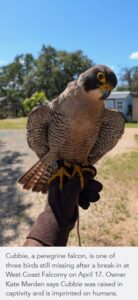
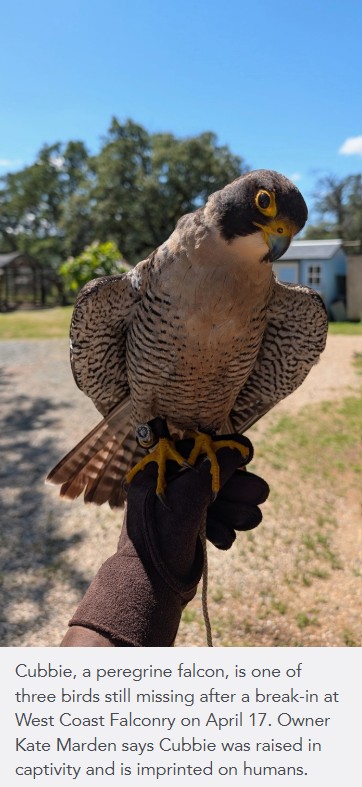
Cubbie, a peregrine falcon, is one of three birds still missing after a break-in at West Coast Falconry on April 17. Owner Kate Marden says Cubbie was raised in captivity and is imprinted on humans.courtesy West Coast Falconry
Vlasak said he had no firsthand knowledge of who was involved at West Coast Falconry, but he was critical of the practice of falconry itself.
“It really breaks my heart to see any sort of a bird in a cage anywhere, or chained to a post somewhere,” he said. “These animals are meant to fly free. They fly miles and miles at a time and perch in trees and do all the things that birds do.”
He compared falconry centers to zoos and circuses; businesses that profit, he said, by keeping wild animals in enclosures. And he disputed Marden’s central concern about the released birds.
“There is absolutely no reason to keep these majestic, wild animals in captivity,” he said, “and contrary to the self-serving statements of their captors, they are perfectly capable of surviving in the wild.”
Marden rejects that framing. She said she knows each of her birds individually and can describe, in detail, why each one cannot survive on its own. Walter has no hunting experience. Cora is blind in her dominant eye and cannot track prey. Cubbie is imprinted on humans.
“If you think you’re doing good,” Marden said, “then you haven’t done your research.”
 Decades of direct action
Northern California has been a center of American animal rights direct action for nearly four decades. In 1987, an arson destroyed the John E. Thurman Veterinary Diagnostic Laboratory at UC Davis — at the time, the costliest animal rights attack in U.S. history. In August 2003, two bombs exploded an hour apart at a biotech company in Emeryville; another bomb, wrapped in nails, went off a month later at a nutritional products company in Pleasanton. A group called the Revolutionary Cells–Animal Liberation Brigade claimed responsibility. The suspected bomber, Berkeley native Daniel Andreas San Diego, spent more than 20 years as one of the FBI’s most wanted fugitives before being arrested in Wales in late 2024. A British court approved his extradition to the United States in February.
Between 2007 and 2009, researchers across Northern California’s UC campuses faced a sustained campaign of harassment and violence. It included months of home vandalism at UC Berkeley, a firebomb at the front door of a UC Santa Cruz biologist’s home in August 2008, and a January 2009 claim by the Revolutionary Cells–Animal Liberation Brigade that the group had sent letter bombs to two UC Davis primate researchers, though no devices were recovered.
More recently, the Berkeley-based group Direct Action Everywhere has drawn hundreds of activists to Sonoma County poultry and duck farms, removing animals the group says are being abused. One DxE activist, 23-year-old UC Berkeley student Zoe Rosenberg, was sentenced to 90 days in jail this past winter for removing four chickens from a Petaluma Poultry facility in 2023.
Marden said she remembered falconry birds being stolen and released in the Petaluma area around 2006 or 2007. Those incidents were never publicly tied to a specific group.
Still searching
The Yuba County Sheriff’s Office responded to the initial call but did not reply to requests for comment concerning any ongoing investigation.
The U.S. Department of Agriculture’s Animal and Plant Health Inspection Service said in a statement that it offered to help capture the birds last week but that West Coast Falconry has not accepted the offer. The U.S. Fish and Wildlife Service did not respond to a request for comment.
Mostly, Marden said, the search has been led by her and her neighbors. Community tips have helped her recover some of the birds now back on the property.
She said she plans to upgrade security with new gates and interior fencing.
Walter, Cora and Cubbie are still out there.